
Charles: What’s in a name?
Charles, is a name largely associated with drama and failure in British history. Odd choice then that the late Queen chose it for her first born son, the current Charles III. Seriously, this is never a fact that doesn’t fail to register with me and illicit some sympathy for the man. With strong family names like George and even Albert, I’m not sure why Her Majesty chose Charles, but, alas! Here we are in another Carolinian Age. But, I digress, back to the original Charles. If you read my post about James who might I add, is taking OFF right now (George and Mary plus a new book by Gareth Russel) then you already have a bit of backstory and a fairly significant fact- Charles was the spare. The spare has become a negative term in our lexicon of conversation thanks to Prince Harry, however, Charles’ story seems to follow that pattern of pathetic all the same.
I first became acquainted with Charles through the movie Cromwell in my high school AP Euro class many moons ago. Played by Sir Alec Guinness, the execution scene always stood out to me. Charles was regal, confident and calm. He walked past his enemies to the block and apologised for nothing, rather he defended himself and then gave himself to his God, the God of divine right kings. It’s powerful, even if I daresay a little B.A! However taking off the cinematic glasses, Charles could have changed his fate so many times and when one does a brief eyeball of his reign, it’s quite frankly unfathomable that he didn’t. Arrogance, and perhaps an inability, or lack of innate learning curve yet again, hit the Stuart dynasty and HARD. James may have been disliked and yes there was an assassination attempt (look up Gunpowder Plot), but he did leave this world and meet him maker with head attached to his neck! However, Charles losing his head would seem less dramatic than England losing the monarchy which is what happened in the years following Charles’ failure to successfully rule and subsequent execution.
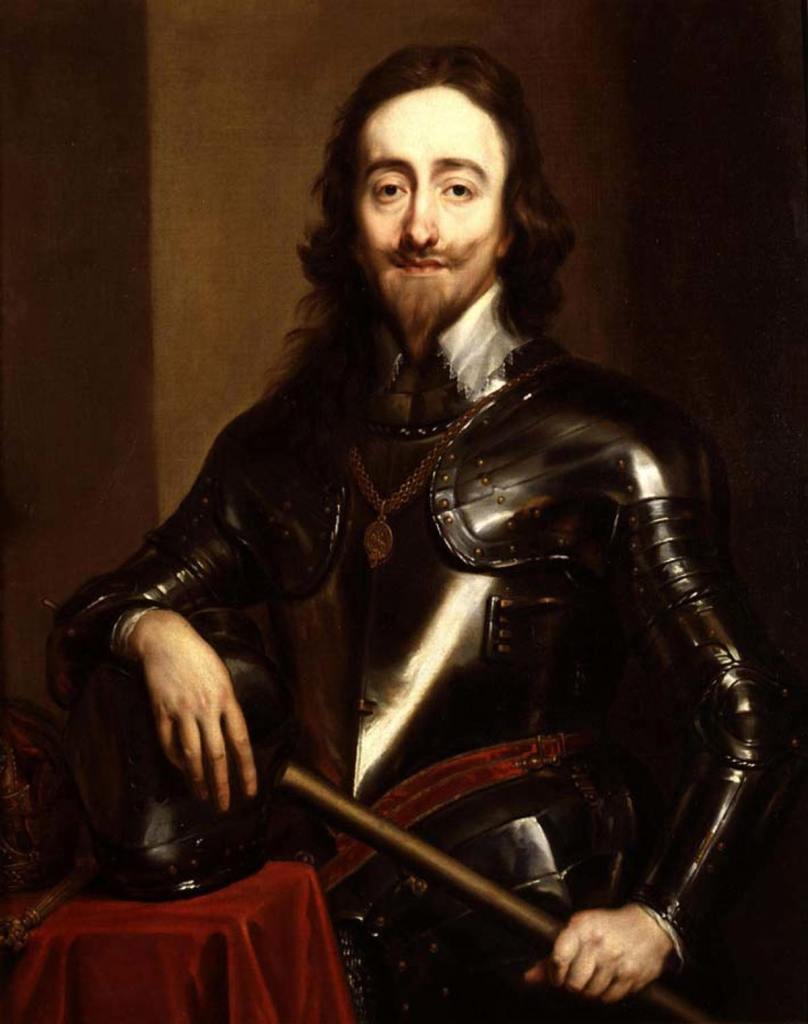
The Spare Heir
Charles was born in 1600, a few years before his father James I, would become the first dual monarch of both England and Scotland in 1603. However, as mentioned before, Charles was to ascend to the Duke of York at best, being that he was the second in line to the throne. His older brother Henry seemingly had the aptitude for the crown as well as the intellect for royal education to accompany it. Charles was allegedly bullied and teased by his older brother and there are some assertions that as a child he was potentially considered less than, maybe even ignored by his father. However, when Henry died from swimming in the Thames in his mid teens he left his 12 year old unprepared and seemingly late blooming brother as the heir apparent. Charles then began to adapt to his future with the proper training as well as creating a close relationship with his father’s favorite George Villiers and allowing the King’s favourite to take young Charles under his wing. Odd as the relationship would seem regardless, his closeness with Villiers would not endear him to those he was going to lead- remember Villiers would be assassinated during Charles’ reign. When his father died in 1625, Charles was a young man ready to take on the English crown with his new Catholic and French wife Henrietta Maria (BIG MISTAKE IN WIFE- devoutly Catholic and FRENCH in a reformed, anti-papal England??) . They would go on to have many children, of which the future King’s Charles and James are included. If you’re wondering if Charles’ children would learn any lessons, or keep the family genes of ignorance going, it’s the latter.
Divine Right Rule in a Magna Carta Country
Whilst James annoyed the English because he came with a sense of entitlement via his belief in divine right monarchy ( a no go papal type of belief in a now firmly fixed Protestant country), he did possess some ability to work within the parameters that the English Parliament demanded. I wonder however if the Parliamentary forces had more hope for Charles and his English assimilation given that he was essentially thoroughly English having come to the country at 3. One would also think that whilst he would have been educated via his father, that he also would have had enough sense to leave behind James’ very Scots ideas as he adapted himself to the English throne. Not the case. Charles would alienate his English subjects and Parliament worse than his father as he projected a much more aggressive form of divine right ideology whilst also creating Catholic alliances via his French wife Henrietta Maria. For the people of England, the new generation of monarchy was starting to look dark and dire.
If you read the James post, you know that James abused his kingly power when he dissolved Parliament after it impeached his love, George Villiers. There were also plenty of other contentious moments as well. However, many gave James credit for having statesman like abilities, Charles was different. Happening simultaneously (because why not?) a new faction of landed gentry was up and coming- the Puritans. As Charles continued to aggressively push his divine right, pseudo-Catholic sympathising agenda, he was being blocked frequently by the new Puritan Parliamentary members in government creating the perfect storm of chaos and soon to come, violence. Unable to get his much desired taxes approved, being deemed tyrannical by the Parliament , and for attempting to push Anglican high church (ritualised practice that whilst Protestant in theology smacked of Catholic practice) religion on the Scottish Presbyterians whilst also alienating the English Protestants with what they deemed Catholic influences, Charles led his country into a Civil War. Hard to imagine with the above mentioned evidence right?
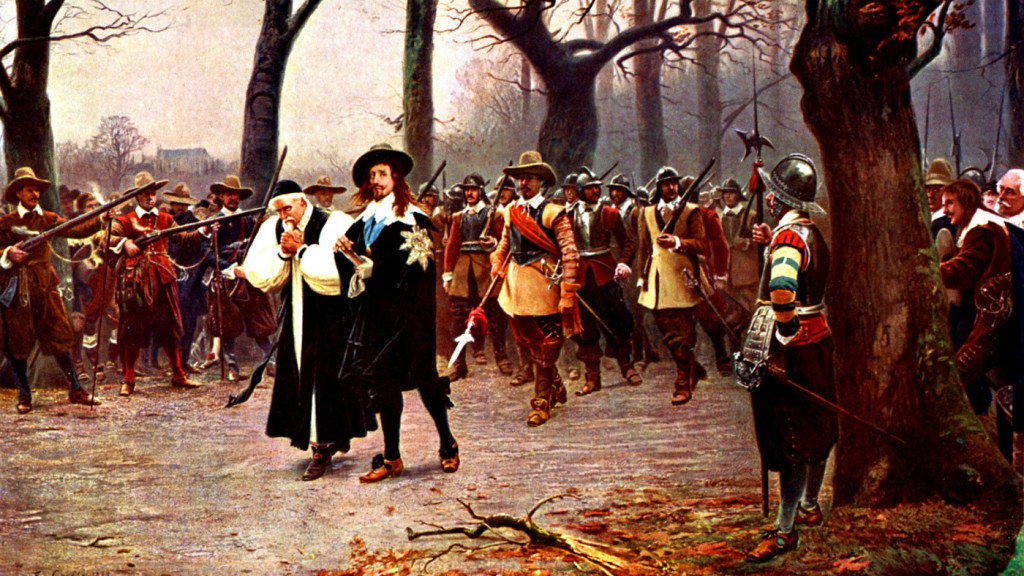
The Civil War
The English Civil War, like all Civil War’s was a sorry state of affairs. Nothing is really gained when a country fights its own people, but in this case it was historic in that Charles and his royalist supporters weren’t just defeated by Cromwell and his New Model Army, Charles was tried for treason and sentenced to death. My students used to ask why the Cavaliers were defeated so badly. A perhaps oversimplified answer could be changing times. The English Civil War began in 1642, smack right in the midst of the 17th century- great change was on the horizon for new classes of people as the world became more commercial and for the English also more colonised. As with the French Revolution, the upper echelons of society often own the most wealth and land but have a smaller sub-set of population. Aside from obvious tactical errors that Charles and his men made, some issues with the Scots and Irish, the other side likely had more muscle and quite frankly, more drive. Regardless, Charles was captured and pressured by the Parliament to implement the long desired constitutional monarchy to which I think we can all figure out- he refused…
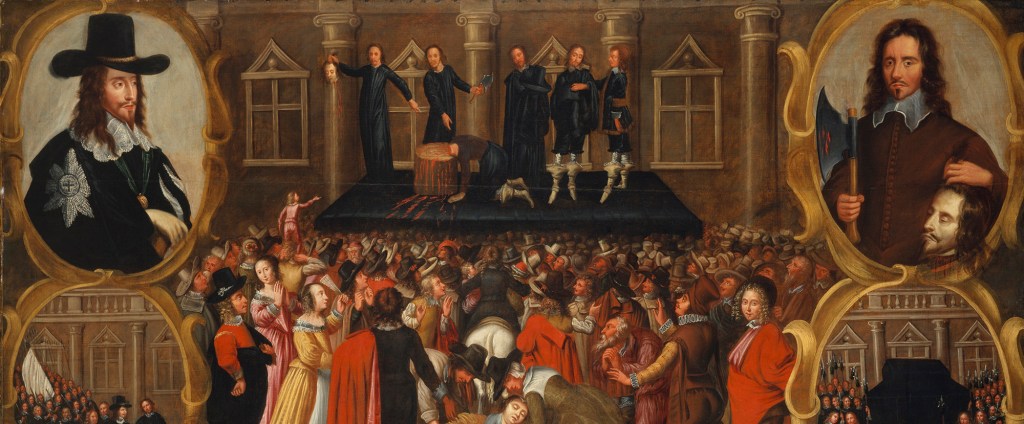
Execution Day
After his refusal, he tried to escape for a bit (really digging himself in deep here) and was tried for treason and sentenced to death. This is a pretty insane idea when you want to examine it. Sure, England has its history of messiness. Think War of the Roses and King’s bumping off other King’s and even little kiddy King’s- eek. However, Charles didn’t die in battle, or get executed by the enemy powers. He was the first and to this date, only English King to be tried, and sentenced to death AND for the death sentence to be carried out. I think this is where a sympathetic image of Charles has come from. In Cromwell, Charles is led past the Puritan leaders who defeated him and of course a grim and crusty looking Oliver Cromwell. He is calm, collected, poised and composed. When the time comes he says a prayer, fixes his hair for his execution and delivers an eloquent speech essentially saying that saying nothing would be an admission of guilt- because in his mind as the monarch of England, he did zero wrong. He is a King, but wishes liberty for his people whilst also using some divine right verbiage showing an inability to understand the kingly limits in England. However his final words before checking that he was prepped for execution was “I go from a corruptible, to an incorruptible Crown; where no disturbance can be, no disturbance in the World.” As much I find him dense, out of touch and ill-bred for leadership, there is something about the whole scene, both cinematic and the real-life eye witness testimony that is sobering and sad. Satisfied with his speech and prayer and having checked his hair cap to ensure a quick execution, Charles placed his hands out in front of them and was met with an executioners blow. The rightful King of England had been executed for crimes against his own people. It absolutely makes you pause and reflect with sadness at what has just happened.
What came next?
Ironically, the man who in effect passed the sentence, Oliver Cromwell, would be the biggest, nastiest hypocrite of all time and actually dissolve Parliament himself when they would not bend to his will. His abolition of monarchy was short lived and a major restoration with Charles II would once again bring the Stuart’s back to the throne.
Did Charles II finally have the learning curve that apparently Mary Queen of Scots, James and Charles I lacked? Nope. Tune in next time for Charles II- why can’t they figure it out?
Link to Cromwell– https://www.youtube.com/watch?v=RzDAWHyt5gU
Sources:
Dr. Brittany Sim lecture notes based on Jackson Spielvogel’s World History
Rebellion- Peter Ackroyd
BBC- The Stuart’s

 A Courtly Affair: A Blog of Royal Intrigue and Modern British History
Leave a comment