
In a particularly riveting episode of The Crown in season 2, Paterfamilias, we get a very granular look at Prince Philip that’s really eye-opening. The episode is centred on Prince Charles, the sensitive son that manly man Philip can’t seem to connect with, being sent to Philip’s beloved Gordunstun school in Scotland. Charles, the ever sensitive future King who wanted to go to Eton, was sent at Philip’s insistence and shocker, it’s not going well. Whilst Philip struggles with the fact that Charles is struggling to emulate his success at the school Philip feels saved his life, the show starts to go back in time to dissect Philip’s turbulent childhood. In reviewing some of the more shocking aspects of his tragic life, the gritty, “just get on with it approach” many find cruel in Philip starts to make more sense. Philip can be a polarising figure, and some antics on The Crown probably didn’t help. Regardless of your feelings, Philip had a pretty traumatic and difficult life. His mother was deaf and schizophrenic, and as a baby, the family was forced to flee Greece, where they were part of the royal family and essentially abdicated. Philips’s father, Prince Andrew, could rent a stately home in France. Still, he’d frequently be chased by debt collectors. His mother, Princess Alice, was taken away for mental health help, which was probably more of a cause than a solution. Philip then really had no family and no home. The fifth child and only boy was passed around between his doting older sisters, aunts, uncles, and grandmother. Philip was clearly happy when he went to stay with his favourite sister Cecile and her children in Germany in the 1930s.
In the episode, we are shown the tragic death of Philip’s beloved sister Cecile and her husband, a German duke, in a plane crash. The uncomfortable part is the allusions that the pair were not just Nazi sympathisers but active participants in the rising regime of the Third Reich. It also portrays a young Philip living in Nazi Germany, as well as a photograph of the Prince saturated in Nazi imagery.
Sadly, a bit of creativity was used in an episode that really didn’t need it- so what was true?
Cecile

Princess Cecile, the third of five children from the union of Princess Alice and Prince Andrew, was ten years older than her brother, Prince Philip. After the subsequent exile from Greece and taking the kindness of many cousins and benefactors, Cecile cosied up to her cousin Georg, who was from the House of Hesse in Germany. Whilst Georg had the title of “Grand Duke”, it was titular only. After the First World War, the various princes of Germany lost their royal claims. Also, being from Hesse meant Georg had some pretty serious ties- his aunt was the murdered Empress of Russia, Alexandra, and his great-grandmother was the “Queen of Europe”, Victoria. Seeing Victoria was his great grandmother, that would also make Cecile his cousin. From Victoria’s reign in the mid-19th century to Queen Elizabeth’s reign, most of Europe was connected to Victoria and Albert and, therefore, Germanic in their heritage- this would include Prince Philip and Queen Elizabeth. What is the long-winded point I’m trying to make? As young people of status with specific expectations regarding their marriages, many European matches would have been related in some way.
In 1931, Georg and Cecile married, and after many years of familial turbulence, which also affected her little brother, Philip, Cecile finally found a permanent home in Darmstadt. Philip spent a happy and stable time with his sister, Georg and their children in Germany during the rise of Hitler and the Third Reich. In the six years Cecile and Georg were wed, a happy marriage produced three living children- Ludwig b. 1931, Alexander b. 1933 and Johanna b. 1936. In the early 1930s, as Hitler made his rise in German politics, like many of the old regime families, Cecile and George were not enthusiastic Nazi party members. However, by 1937, they had officially joined the party. This could be, of course, because they had changed their mind and decided to buy into the fanatic Nazism that had captured many of their friends and family, or as an aristocratic family, they capitulated when by 1937, Hitler was situated in a place of unlimited power, and they simply did not want the wrath the Nazi’s had free reign to bring.
Ostend
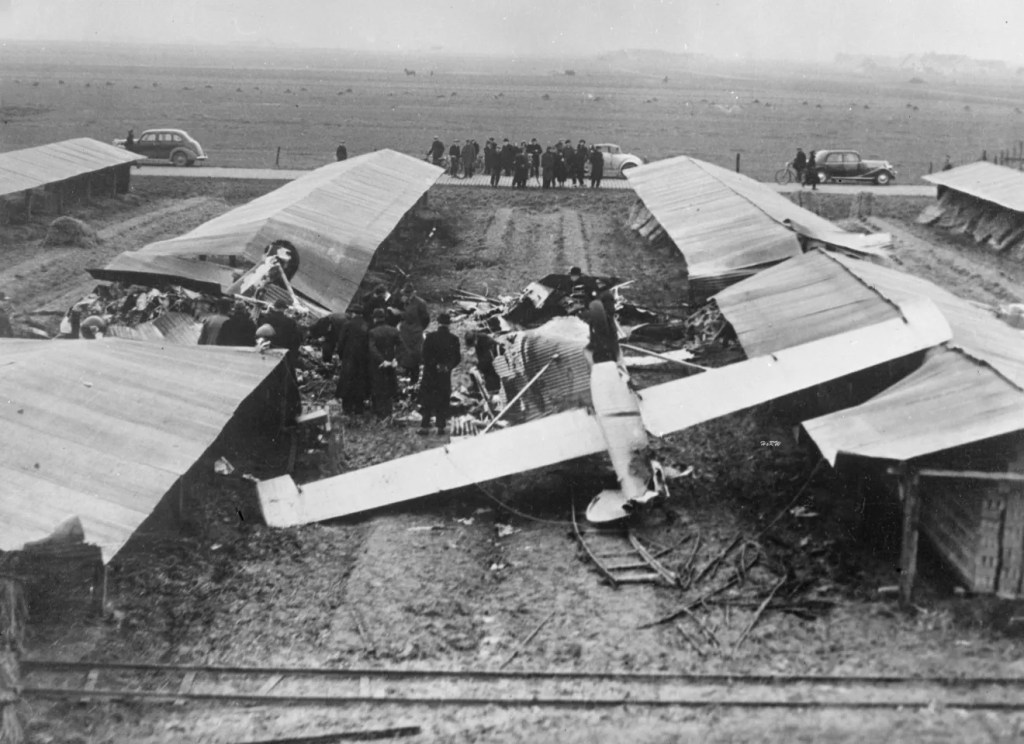
In The Crown, there is a scene that pseudo-suggests in November 1937 that a heavily pregnant Princess Cecile and her “Nazi brood” board a plane for England because of Philip. Whilst there’s a good deal of creative license in The Crown, this is particularly cruel as the flight to England would be the last moments of Cecile’s life. 16 November 1937, Cecile, Georg, George’s recently widowed mother, Ludwig and Alexander boarded a flight to England for the wedding of Georg’s younger brother to English aristocrat Margaret Geddes. At some point over Ostend, their plane descended dangerously low, struck a chimney, removing its wing and engine, and crashed, killing all on board. Flight conditions and visibility were poor, which was the initial reason for the crash. The investigation and post-mortem of the plane, however, showed that Cecile’s unborn child was in the wreckage, suggesting that the child had been born. It is now thought that the flight did not have any issues but rather that the Princess may have gone into early labour, causing a need for the plane to have an emergency landing that went disastrously wrong. Georg’s younger brother Louis’ wedding went ahead. At its conclusion, Louis collected the remains of the family to be taken back to Darmstadt for burial. Johanna was not with her family but unfortunately succumbed to meningitis two years later.
The family, then, was not going to the UK because Philip was in distress, but rather for a routine, planned family event that just went horrifically wrong.
The Funeral

After Louis brought their remains back to Germany, the family was laid to rest a week later, on 23 November. Whilst many came to pay their respects to the aristocratic family who was all but wiped out, a large contingency of Nazis attended and with them came their trademark branding. Throughout the funeral procession, it seemed at times as if the family was overshadowed by Swastika insignia and in the middle of the procession was a young 16-year-old boy, mourning his sister who sometimes was like a mother. His grief was drowned out by mourners lining the street shouting “Heil Hitler”, which is, unfortunately, what was memorialised in the newspapers the next day and, thus, historical memory. In 1937, Cecile and her family’s tragedy would have made headlines, but the world of 1937 was very different. Their story and Nazi association, in tandem with the newspaper coverage, decked out in Nazi insignia, would one day cause trouble for Philip and overshadow their family’s grief. However, at that moment, World War II was still 2 years away, and the discovery of the crimes of the Reich was even further. Further still was 1947, the year that Philip, a pseudo-orphan, derogatorily referred to by the Queen Mother as the “Hun”, would marry a young Princess Elizabeth, and the less savoury aspects of his tragic past would be brought to light and used against him by those who found him less than worthy.
Cecile’s life, like Philip’s, was marred with tragedy, insecurity and grief. However, in her short life, she cared enormously for her brother. Like her other sisters, she tried to shield him from the reality of their exiled lives and the issues with their parents. As far as Cecile and Georg, we will never know for sure if they joined because they believed in Nazism or felt it was inevitable for their own survival. Sadly, Cecile’s life has been so mangled with that of the Third Reich, given that her and Georg’s reluctance (when most of their friends and German family had been Nazis for years) lasted well into Hitler’s reign. It is also sad that The Crown attempted to not only depict them as Nazi supporters without doubt but also that their death in any way had to do with a teenage Philip. Whilst the Royals have denied watching The Crown, it is alleged that Philip did see this episode/ know of its plot line and was devastated by its portrayal. This is an instance where sticking with the actual story may have been just as intriguing as the creative license.
The Duke of Windsor and his Nazi sympathies, though, now that’s a very different story because that one is a true story. TBC…
** Sources consulted- Phillip Eade “Young Prince Philip: His Turbulent Early Life”.
** Alamy Stock Photos used.

 A Courtly Affair: A Blog of Royal Intrigue and Modern British History
Leave a comment