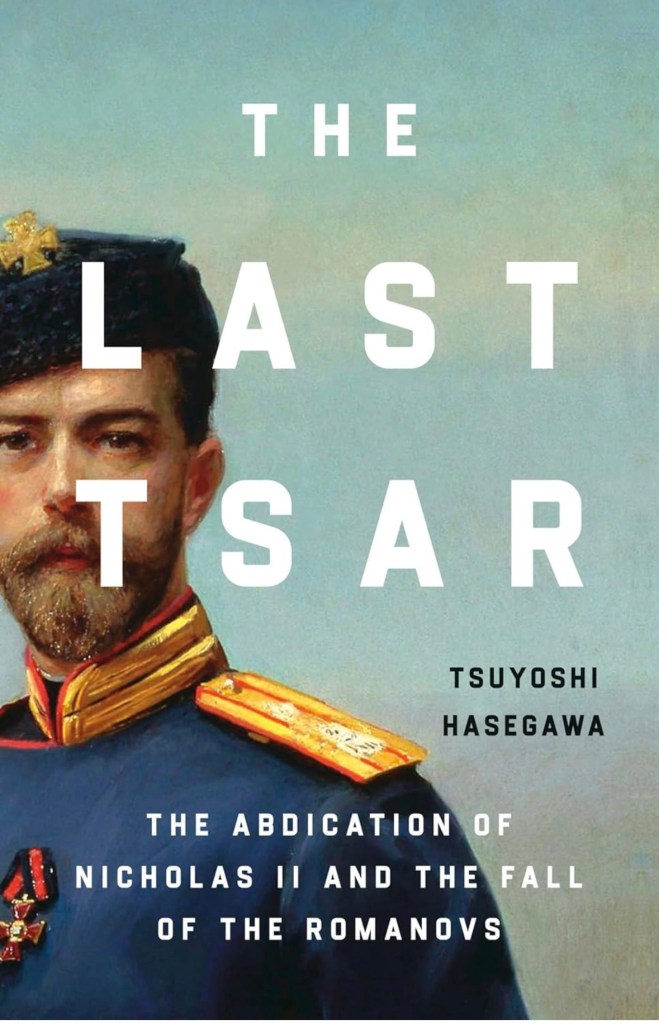
I know, I know. The Romanovs? Not British! True, but anyone who knows me or has taken a class I’ve taught knows I love a good couple days to talk all things Romanov and Russian Revolution. I’ve read and watched quite a bit over the years including the glamourising epic Nicholas and Alexandra. However after reading Helen Rappaport’s book, Ekaterinburg, that solely dealt with the final moments of the family’s lives, there’s nothing glamorous about the Romanovs and I constantly get this horribly dark feeling every time I go down the Romanov “Rabbit Hole”. However, whilst at the mothership last week (Barnes and Noble), I couldn’t help but be pulled in by The Last Tsar by Tsuyoshi Hasegawa. I mean literally- saw it from across the room and had to pick it up!
Hasegawa, who has spent years examining multiple facets of the Russian Revolution claims to have unearthed significant new archival data revealing exactly how the complex coup that took down the dynasty and forced the abdication of the Tsar occurred. The author focuses largely on telegrams from the days leading up the revolution to show how overwhelming and all encompassing the drama was for all involved.
This is not a monograph that will focus on the more Hollywood facets of the doomed love affair of Niki and Alix but instead shows how over a four year period, the Tsar made every incorrect move he could have made politically and personally to essentially guarantee not only the Revolution of February 1917, but also the assassination of the Imperial family in 1918.
Hasegawa, does an exceptionally thorough job showing the political ills at play- ministers who were simply unfit picked by the Tsar under the influence of Alix and Rasputin, facing off against those who had the ability to understand how catastrophic the political, social and economic scene in Russia was becoming. He reviews many different political elements all seeking to remove the Tsar that go beyond Alexander Kerensky and his provincial government, but also shows something so much larger than the later Bolshevik takeover best known to history. Ironically it seems all classes, parties, even nobility wanted Nicholas out and for his son to inherit the throne under a regency with his brother Mikhail. Even as the revolution was happening in the span of the 3-4 days from the beginning to abdication there are so many different sides and agendas it can be difficult to keep up with the characters – the what and why and where they are on the political spectrum as well as who they sought ally themselves with and go against. However, the one take away from everyone was Nicholas needed to abdicate to give Russia any shot of success. Yet, in reading the book it’s obvious that self-preservation came before mother Russia with many of the revolutionary figures as their egotistical behaviours and for some, lack of capability, hindered their own cause in February and March of 1917 creating an even bigger disaster that would ultimately cause their downfall in the following months.
Hasegawa’s portrayal of Nicholas’ inner turmoil at failing to grasp that the autocracy of his father, that he had given his oath to, was no longer a viable option for his people, coupled with the fact he himself as a person could not emote autocracy took the typical “weak ruler” narrative a bit further which I enjoyed immensely. Hasegawa shows that Nicholas dismissed letters, telegrams, pleas from his family, and the Duma to turn Russia into a constitutional monarchy up until the last minute, thus removing and chance to save Russia as well as his family. When the revolution itself broke out in Petrograd, depending who had contacted him, he wouldn’t even consider their information as it often contrasted info he was given from trusted advisors who unfortunately were wrong and self-serving. More or less, Nicholas lacked the self-awareness to understand when he was being given actual intelligence versus flattery and would rather believe what he wanted to hear instead of what was real.
I’d always understood Nicholas to be ineffective as a ruler, but this was something different and Hasegawa paints this portrait through archival sources making it even more fascinating. Also knowing how this whole tragedy ends, it was frustrating to see how many chances the Tsar and the Imperial family had to work with the Russian people and avoid their own fate. However, where I was a bit turned off even though I didn’t exactly disagree was his portrayal of the Tsarina. It’s no secret that Alexandra was controlling and fairly manipulative over her weak husband, constantly evoking guilt and poking at Nicholas’ masculinity, or perhaps the lack thereof. Hasegawa makes use of correspondence between the two many times showing how Alix would guilt Nicholas into hiring and firing the wrong minister, or would throw a temper tantrum when Nicholas made a political move on his own. Yet, the language the author frequently uses to describe Alexandra and analyse her motives came off a bit emotional at times as if he himself had a personal grudge against the empress- a case of not what you say, but how you say it maybe? Just struck me as a bit informal and distracting from what the author was trying to do. At times I also felt the flow and structure of the book a bit abrupt and choppy and the frequent use of full and difficult Russian names over and over when a surname would have been fine, made some things tedious. Lastly, he gets a bit involved with the current American climate with some comparative comments re:Rasputin. I understand the point the author was trying to make but regardless I want to read a book about the Romanovs. I can turn on the news if I want hear the state of American current affairs.
Overall, the book is detailed and despite some of my feelings on takeaways, it focuses on the coups, the abdication and all of the political insanity happening behind the scenes which is never covered in the various publications, films, docs and so forth regarding the fall of the Romanovs. Once you get past the contextual chapters and start moving through the days leading up the abdication, it’s obvious where Hasegawa’s strengths are as the book becomes a page a turner and it’s hard to put down.
It’s a different perspective that adds to the historiography. Not exactly academic, but a weight class or two above your typical history narrative at the bookstore.
4/5
Don’t forget to follow A Courtly Affair on Instagram @acourtlyaffair!

 A Courtly Affair: A Blog of Royal Intrigue and Modern British History
Leave a comment