The Crown, the Romanovs, and Royal Guilt
I know, I know, I know… after months of being haphazard with some posting, I’m suddenly releasing Russian history post after Russian history post. I know what you’re thinking — this is a British blog, and yet I’ve reviewed a book on the Tsar, War and Peace, and now this Crown Corner connecting the Romanovs.
But at the root of it all, it’s related — and frankly, fascinating. England preserved itself in the face of a changing 20th century. Yet, Russia has become something so severe that Nicholas II, of all people, starts to look… reasonable.
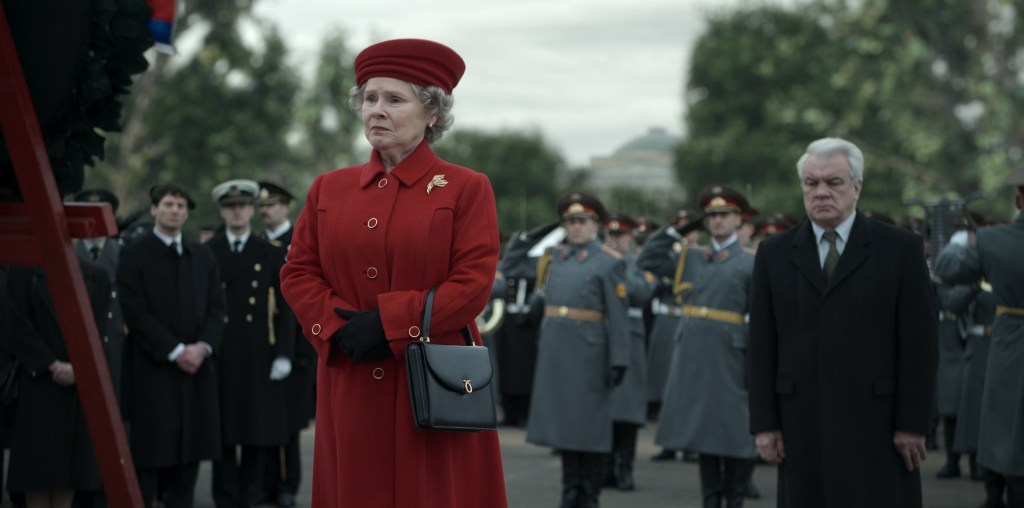
So, after reviewing that book on the abdication of Tsar Nicholas II, I decided to do a post on an episode of The Crown that actually features a Romanov storyline. In Season Five, there’s a particularly poignant episode titled Ipatiev House, in which Queen Elizabeth and Prince Philip help the Russian government in the 1990s locate — and eventually bury — the remains of the Romanovs after the horrific, tragic events of July 1918.
In the episode, it’s evident that Queen Elizabeth is trying to reconcile her family’s role — or potentially their lack thereof — in the execution of the Russian royal family. Tsar Nicholas had been very close with his cousin George V, Queen Elizabeth’s grandfather. Throughout the early days of the Russian Revolution, before things became utterly bleak, the Romanovs expected that they would be able to escape to England for asylum- check out Helen Rappaport’s work for all the ins and outs! But as the days dragged on, and no help arrived from George, they began to realize that escape might never come.
In The Crown episode, the Romanovs are awakened in the middle of the night at Ekaterinburg, where they had been living under guard. They’re told to dress and are led to the basement to wait. The family begins to believe they’ve finally been released by the Bolsheviks and will be taken to safety — perhaps even to England.
But instead, they are brutally executed in one of the most horrific scenes in modern history. A scene that’s only been crafted on film a few times and those rare moments are so brutal it seems like too many.
So, what really did happen? Did Queen Elizabeth harbor guilt over her grandfather’s inaction — something she felt needed to be reconciled? Did she and Philip play a pivotal role in pushing the Russian government to find the remains and finally give the Romanovs a proper burial?
George and Nicky
Before the Great War broke out in 1914, royal links throughout Europe were a tangled mess of cousins — almost all of whom traced their lineage back to Queen Victoria and Prince Albert. Victoria and Albert’s nine children married across the continent, and by the early 20th century, the thrones of Europe were filled with their descendants. Who in turn also married.
At the turn of the century, a generation of cousins — England’s George V, Russia’s Nicholas II, and Germany’s Wilhelm II — were friendly, competitive, and often enjoyed each other’s company.
George and Nicholas, in particular, had an especially close relationship. While not cousins by blood, they were cousins by marriage. George’s mother, Queen Alexandra, was the sister of Nicholas’s mother, the Dowager Empress Maria Feodorovna (born Princess Dagmar of Denmark- better known as Minnie). Nicholas’s wife, Alexandra of Hesse, was Queen Victoria’s granddaughter — and a first cousin of George. This familial line is also where the hemophilia that plagued the Russian imperial family as well as other monarchies first originated.
Their families had visited one another, spent holidays together, and attended each other’s weddings, funerals, and baptisms. Yet, these seemingly incestuous bonds didn’t preserve peace. In fact, when war loomed, they arguably made things worse — as the monarchies of Europe were dragged into war with a tragic mix of old-world loyalty and modern weaponry.
War, Weakness, and Abdication
When war broke out in 1914, the alliances that had helped cause the war placed Britain and Russia on the same side. Initially, it looked as though both empires might crumble under the weight of German military power. But as the war progressed — Germany’s dominance faltered, trench warfare bogged down the front, and Britain began to rise — Russia spiraled downward.
The truth is, Russia had no business engaging in a war of this magnitude. It was, in essence, bringing knives to a gunfight.
Even before 1914, Russia was in decline. Nicholas, who had taken the throne long before George became king, had been locked in a cycle of failure from the day of his coronation. His father had been stern and autocratic. Nicholas wanted to be so like his father — Alexandra certainly pushed for it — but he didn’t have it in him. He has often been described as weak, unintelligent, prey to flattery, and dangerously oblivious. Sadly though, at the end of the day, he thought he was ruling in the best interests of his people, God’s representative on earth.
His rule was marked by missteps, like Bloody Sunday in 1905, when peaceful protesters were gunned down by palace guards. His wife, Alexandra, was under the influence of a mystic holy man, Rasputin, leading to rumours of sexual impropriety. Rasputin, claimed he could save their hemophiliac son leaving him indispensable to a superstitious and guilt stricken Tsarina. Meanwhile, political unrest swelled.
Calls for constitutional monarchy were ignored. Nicholas resisted reform at every turn.
Ironically, at the outset of the war, a wave of patriotic fervor briefly boosted the Tsar’s popularity. But it didn’t last. Russia was utterly unprepared for the war, and Nicholas lacked any real military competence. While he took command at the front, he left the capital vulnerable — and the political climate behind him turned volatile. Though he had allowed for the creation of a Duma (parliament) in 1905, its powers were minimal. Political factions grew in influence as a result. While Nicholas was absent, the February Revolution in 1917 forced him to abdicate — both for himself and for his son. His brother, Grand Duke Michael, refused the crown.
Just like that, imperial rule in Russia was over.
The democratic hopes of that first revolution would be short-lived. By the end of the year, the Bolsheviks launched a second revolution — the October Revolution — seizing power and beginning what would become over 70 years of Soviet rule.
Asylum Denied
After his abdication, the Provisional Government didn’t want to be responsible for the imperial family, but also didn’t know what to do with them. Even the Bolsheviks, at first, weren’t sure. Over the next several months, the Romanovs were moved between locations, living under increasingly strict conditions. As their situation worsened, they began reaching out for asylum — especially to England.
At first, Nicholas likely assumed that England would welcome them — especially given his family ties. George V may have even hoped to offer refuge. But what neither of them realized was how politically dangerous such a move would have been.
To the British Prime Minister and Parliament, Nicholas was no longer a cousin — he was “Bloody Nicholas,” a failed tyrant whose violent reputation preceded him. The British public, still clinging to their own fragile empire in the face of a brutal war, had no interest in hosting a fallen autocrat. No one needed a perceived communist threat coming to Britain undermining the government or monarchy- especially given that the royals themselves had a difficult enough time during the war reshaping their image as properly English, away from their German heritage.
Ultimately, George V’s government made the call not to offer asylum — and perhaps it was the right political move for the time. But for a royal family built on bloodlines and dynastic loyalty, it had to feel like betrayal. That sense of abandonment — of “family” being powerless, or unwilling, to help — hangs like a shadow over the entire Romanov tragedy.
The Crown’s Reckoning
Which brings us back to Queen Elizabeth in the 1990s.
In The Crown, there’s a deep sense that Elizabeth is reckoning not just with history, but with the moral weight of monarchy itself. Her trip to Russia, alongside Prince Philip, isn’t just diplomatic — it’s personal. When she pushes for the remains of the Romanovs to be recovered, identified, and buried, it feels like an act of reconciliation. Not just for the dead, but for the living. A way to quietly acknowledge a century-old failure without rewriting the past. However the one re-writing and reconciling the past was show writer (and a brilliant one at that) Peter Morgan.
So the facts- The assumed remains of the Russian imperial family were likely discovered in the late 70’s, maybe early 80’s but not investigated and exhumed until after the fall of the USSR. Therefore the scene depicting the Queen almost mandating that Yeltsin track them down, ID and bury them are false. Elizabeth herself also didn’t attend the reburial when it actually took place in 1998- not 1994 as the storyline depicts. Despite being found in the early 90’s, it took forensic investigators some time to 100% positively ID the Tsar which put the official ceremonies on hold. Therefore Queen did make a official state visit in ‘94 as depicted in the show, but it was purely for diplomatic purposes.
Philip’s own connection adds a poignant twist and has more direct truth . He was a great-nephew of the Tsarina and donated DNA to help identify the bodies found in the forest. So therefore, the royal family, after nearly a hundred years, finally did something to dignify the memory of their murdered cousins. However outside of submitting a DNA sample, he was less directly involved than the show has let on.
Was it totally legit? Of course not. But the revisionist history still matters. History can’t be undone, but it can be remembered properly. Sometimes I think historical fiction exists because the “what could have been” can be as important as what did happen. It’s the philosophers in all of us who muse the meaning life and causality of historical events that always wonder as much about the “what if” as the concrete facts.
Maybe Elizabeth did feel guilt — not for something she did obviously, but for something the Crown didn’t. And maybe helping to give the Romanovs a proper burial was, in some quiet way, her response and the reason Morgan wrote the episode in this manner.
For more on this: read Helen Rappaport’s “The Race to Save the Romanov’s”.

 A Courtly Affair: A Blog of Royal Intrigue and Modern British History
Leave a comment