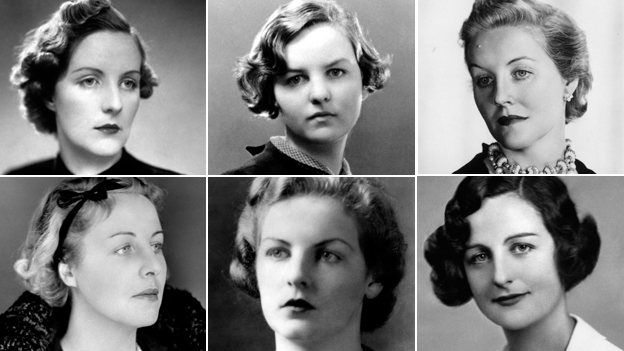
A review of “The Six” & “Outrageous”.
Being a consummate buyer of books, even when there’s no time in sight to read, I had been holding onto the Six, by Laura Thompson for some time.
As a break from my professional reading on Scottish intellectual history, I wanted to love this book — to page through the whole thing in a night, unable to put it down.
I didn’t.
In fact, it took me weeks. And that was even with Audible helping me catch up in the car.
I mean, it theoretically has everything you could want in a page-turner: a British aristocratic family trying to survive the death of the aristocracy in pre-war Britain. One sister marries a communist. One becomes Hitler’s favorite. Another helps launch fascism in England. One is a bestselling novelist. And it’s all true! But somehow… it just fell flat for me.
The Six is about the infamous Mitford sisters — Nancy, Diana, Unity, Jessica, Debo, and Pamela. They were aristocratic stock, struggling to stay afloat as the tides of the 20th century turned against the old order. Each of the sisters became famous in her own right. Nancy was a bestselling author. Diana married the Guinness heir, only to leave him for the despicable English fascist Oswald Mosley. Unity was an awkward type who hit her emotional and developmental stride in pre-war Germany and became a personal friend of Hitler. Jessica eloped with a communist and went to fight Franco’s fascists in Spain. Pamela was largely forgotten, and Debo — the youngest, who managed to stay out of the political fray — became the Duchess of Devonshire and escaped the family shame.
There’s no denying they’re fascinating. But Thompson, the author, focuses almost obsessively on Diana, for whom she seems to have an uncomfortable fondness. Diana married her brute fascist husband at Hermann Göring’s house and later claimed she couldn’t believe someone like Hitler could have organized the Holocaust. She was imprisoned during WWII for her Nazi connections — connections that haunted her, mostly because she refused to be haunted by them. She was oddly unapologetic. And as the book goes on, Thompson’s tone toward Diana grows increasingly giddy and admiring — it becomes uncomfortable to read.
Meanwhile, Unity — Hitler’s right-hand Brit until her failed suicide at the outbreak of war — is much easier for Thompson to label morally corrupted and overzealous. But I didn’t see much difference between the two women. Nancy, the successful author, certainly gets her due, but since she was estranged from Diana for much of her adult life, even her storyline feels judged at times. Pamela is mostly ignored. Jessica and Unity get a fair amount of attention — which is fitting, given how close they were in childhood and how drastically they diverged politically.
And that divergence is what intrigued me most. The book avoids answering the one big question I carried throughout: Why? Why did six aristocratic women — raised to make good matches and uphold tradition — become so politically radical in such opposing ways? Thompson offers a few suggestions: issues with their mother, obvious financial tensions… but still. This was a family oddly enamored with fascism, whether its English version or Nazism, in an era that supposedly prized British patriotism. There’s something unresolved there.
This summer, to add to the Mitford lore, the series Outrageous debuted on BritBox. Given how lukewarm I felt about The Six, I was going to skip it — but after doing some research, I found Outrageous is actually based on The Sisters: The Saga of the Mitford Family by Mary S. Lovell, not The Six. That intrigued me.
The series ends just before WWII begins, with Unity still fully functioning as a nut-job Nazi and Diana desperately trying to sell Mosley’s fascism to the British public — all while Nancy plays the role of moral compass in the family’s slow political unraveling. I liked the series enough that if there’s a season two, I’d watch it. But there was still something a little off.
The acting was excellent — especially Bessie Carter (British acting royalty: daughter of Jim Carter from Downton Abbeyand Imelda Staunton, aka Dolores Umbridge). She was absolutely phenomenal. But the series tried to be modern in some odd ways, and I never got that all-consuming, immersive period-piece feeling like I’ve had with War and Peace or Poldark.
Truthfully, maybe the whole Mitford saga just isn’t for me. There’s a morbid fascist fascination at the heart of it that I’m just not particularly interested in.
The Six: ★★☆☆☆ (2/5)
Outrageous: ★★★★☆ (4/5)

 A Courtly Affair: A Blog of Royal Intrigue and Modern British History
Leave a comment