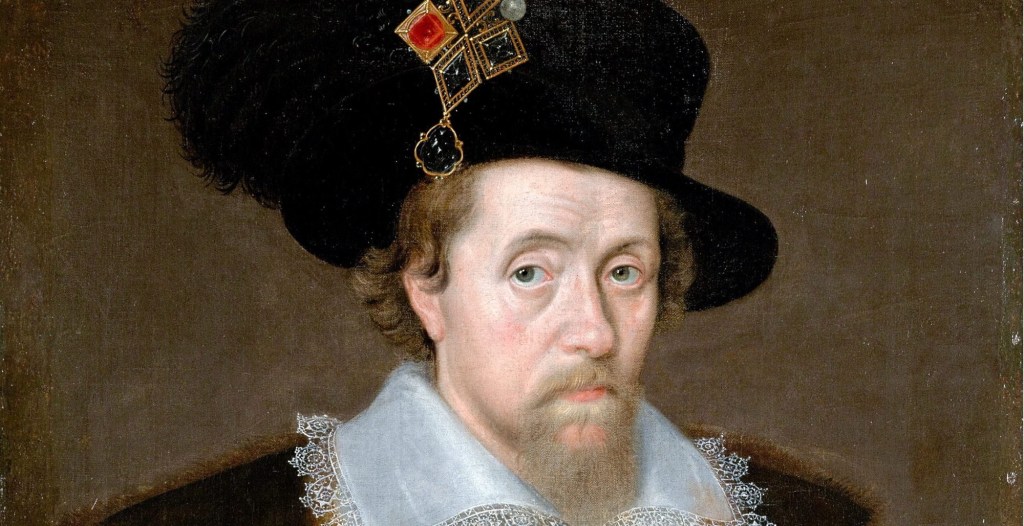
Last week we looked at the woman who started it all Mary, Queen of Scots. This week’s focus, her son James VI/I is making quite the comeback in 2024, and I’m not sure it’s the one he would have wanted. Thanks to the Starz series “Mary and George” with Julianne Moore, a particularly private part of James’ life is back in the spotlight- his alleged affair with his “favorite” George Villiers, the 1st Duke of Buckingham. Sexual preference aside, the portrayal makes James seem a bit odd and at times perhaps even unhinged which I’m not sure is wholly accurate.
Complex, contradictory and seemingly self-sabotaging, James would sire a dynasty that would last 111 years. The dynasty would not be well remembered though- his son and heir would be executed and his grandson driven into exile whilst the monarchy was abolished in the name of unfair treatment from the Stuarts. His other grandson would willingly give up the throne when his fate looked similar to that of his father’s. However, from 1603-1714 under the Stuart’s England became a colonial empire and amassed a power and prestige that even its French rivals couldn’t always best despite their absolute abilities and massive fortune.
Early Life
If you had a chance to read the blog on Mary, Queen of Scots, you are already aware that James was her son with Henry Stuart, or better known as Lord Darnley. Born in 1566 and soon after given up to his uncle and other regents as an infant when his mother was exiled, he became king upon her abdication. Obviously, James’ childhood was fraught with horrific trauma very similar to that of his mothers. He often found himself easily influenced by not the greatest of courtiers and it was then that James’s sexuality started to be questioned as men who could gain influence, also seemed to be men to whom James was attracted. Could this have been an allegation out of jealousy to make the king seem weak and effeminate? Absolutely, Elizabeth I found herself in this type of gossip frequently as well.
However, as James entered his 20’s he started taking a greater role in state affairs, but whilst raised in Protestant doctrine (likely as the potential English heir), much of his behavior in Scotland resembled a king who did not feel his power was limited. He eventually wrote a book outlining his theory on monarchy and stated that it was God given through divine right- a very papal outlook that would be vehemently frowned upon in England. Topic matter aside, James was an accomplished writer and poet who supported the arts. This is important as the Scots are often accused in the 16th and 17th century as being backwards. Nevertheless, it is evident through James and his patronage that he prioritized culture for his people, yet this would end when his court would move South to London, abandoning his native Scotsman. In moving the royal center from Edinburgh to London, the Scots would lose their direct line to their monarch and all the favors and privileges that came with it. He also prioritized some sketchy superstitions though, like a belief in witchcraft, penning a book on witches and demons.
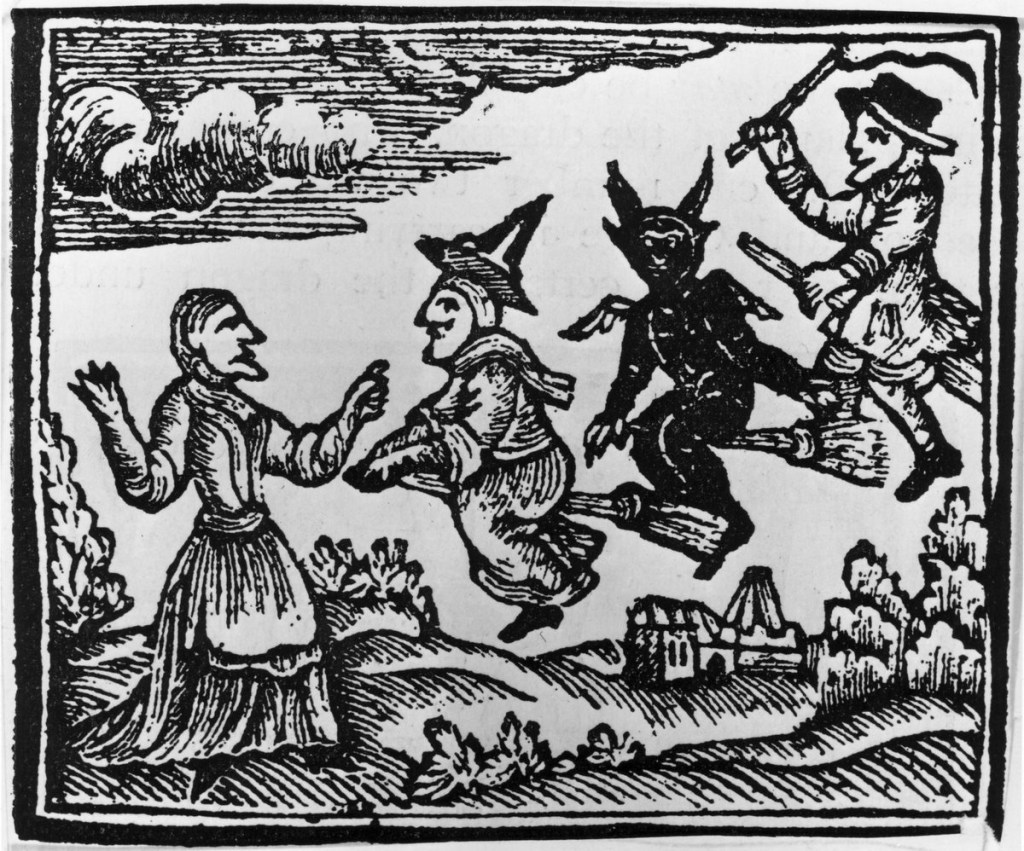
Agnes Sampson
Cringe aside, James would play a large part in one the most tragic witch trials of the 16th century. Betrothed to Anne of Denmark, Anne encountered a frightening storm attempting to cross the sea to London for her wedding and had to turn back. James, for whatever dramatic reason, decided he would go to get Anne. This story would be all well and good, had he not used the situation to insert allegations of witchcraft regarding the cause of severe weather. The woman who took the blame was a small-town Scottish midwife Agnes Sampson, who had helped countless Scottish women deliver their children, as well as who had provided care to her local residents. She was trusted and respected. I’m not going to get into evidentiary support and so forth, because there is none. Outside of our love of “spooky season”, witch folklore is not real. Yet it was for the zealously religious in the 16th and 17th centuries. As is often the case like in places like Salem, once the paranoia begins, it spreads quickly and neighbors turn on friends. Regardless of what happened, Agnes found herself tried and tortured in what can only be described in modern terms as a brutal sexual assault. Lucy Worsley (Queen!!) does a fabulous episode of her series “Lucy Worsley Investigates”, where she paints Agnes’ tragic story against the backdrop of a King desperate for Protestant clout to prove to his cousin in the south (Elizabeth) that he is a fit Protestant heir. Apparently as James aged, he moved away from his belief in witchcraft, but unfortunately, what happened to Agnes and countless others under his watch was already done.
1603- King James of Scotland and England
Odd superstitious flaws aside, James did get his wish when Elizabeth died childless in 1603. As the best “biological” fit, James VI of Scotland was coronated James I of England AND Scotland- this is a big deal as both the English and Scots had attempted through YEARS of warfare to make this dual monarchy possible. Not to mention it was a Scot taking the English throne and now the other way round! Despite his genuine claim to the throne and his potential to be a decent leader, James is a figure who is best described as someone who couldn’t get out of his own way. Well educated, creative and a patron the arts, it’s a shame that he couldn’t have initiated a Golden Age, especially considering the rapid overseas colonization that was beginning in the 17th century and the riches that would soon come pouring in during the reigns of his heirs.
His issue was that his belief in the divine right of kings brought him into conflict with Parliament frequently, leading to a series of political disputes that would be continued by his son and have dire consequences for their political legacy. As a reminder, England had developed on a different path because of the Magna Carta and then subsequent developments in the 16th centuries. James came in with a very Louis XIV kind of attitude- God put me here and only HE is higher than me. In a country with an already established parliament, this was not going to fly. PLUS Divine Right smacked of Catholicism in a country trying very hard to remove any papal influence. It would be viewed as abuse by the MP’s.
His personal life was also marked by scandal, with accusations of favoritism and corruption tarnishing his reputation. Most notably, was the accusations of his favoritism being related to his suspected bisexuality. Every monarch has favorites that are influential over their reign, and most if not all are disliked by the court and other more knowledgeable advisors. However, we need to acknowledge the danger that sex and politics can have when mixed (remember James’ mom and dad?). It’s one thing to have an influential friend, it’s another to have a major influence that has such strong emotional and physical ties. It’s a different type of power. One that the people around the king (mostly out of jealousy, some of legit concern) would have found troubling.
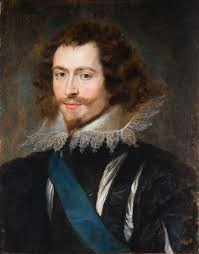
George Villiers- Favorite or Favorite?
Whilst James had a few overbearing influential men in his life that have been described as “lovers”, none was as threatening to the court and Parliament as George Villiers who in the 14 years he was a favorite, collected title after title including lofty positions like head of the Royal Navy- ceremonial position, but still! Going from Royal Cup Bearer to the Duke of Buckingham, he frequently got things for his friends and family which irked his counterparts even more. While historians still argue over whether the men were in fact sexually active together, James was tied to George like no other and frequently took his advice. Given that James was spending the better part of his reign intentionally aggravating Parliament and becoming in their eyes a bit tyrannical, it became easy for courtiers and MP’s to take their aggression out on Villiers in the place of the King. When Parliament became overly frustrated with his poor leadership and lack of effort, they tried to impeach Villiers. As a result, James dissolved parliament- TWICE! All to protect Villiers. When James died in 1625, his son Charles I kept Villiers on. At this point, Villiers had to go. In 1628 he was assassinated by a man in the armed services who had believed he had been passed up for promotion because of Villiers nepotism – the assassin was considered a hero. Eek.
The Heir and The Spare
James and his wife Anne of Denmark, only had 3 of their children live into the adulthood. Fortunately for James, 2/3 were sons. Unfortunately, his heir Henry, who has been raised with all the trappings associated with kingship and leadership and was well rounded in the arts, would die at the age of 18. Athletic and popular, he even made his father jealous when the English people seemed to prefer him over his father. Not a bad thing to have people like the future King and Prince of Wales but difficult when as King they clearly prefer him to you (Think Charles III understands that well). In November of 1612, Henry died after a bout with typhoid. It is thought that he caught the illness whilst swimming in the Thames.
The nation was actually devastated and this in an important part in the Stuart’s reign. Almost like Arthur Tudor Vs. Henry VIII, we have to wonder how much different things would have been. People tolerated James and his Scottish ways and proclivity towards absolutism, but perhaps Henry would have been different. Even more unfortunate, his younger brother Charles always in Henry’s shadow and who he allegedly frequently teased, now as teenager was the heir apparent. Charles I already behind in the education of a king, would mold himself very much in the views of his father and further unravel the power of the Stuart’s by creating menacing conflicts with Parliament as well as the Irish and the Scots.
Final Years
As James entered into the second decade of his reign, he began to experience poor health. Known to drink heavily, James was already in bad shape from gout when he came down with dysentery while also recovering from a stroke in March of 1625. James died on the 27th, 3 days into his 22nd year as monarch.
Despite his issues with parliament, he was generally liked by the English people. The regular run of the mill people who do not get involved in state affairs knew that taxes weren’t bad and there was no war during his reign- this is the stuff that keeps people happy. His unification of England and Scotland laid the groundwork for the eventual creation of the United Kingdom which would bookend the Stuart Dynasty. England also began to amass colonies under James- Jamestown, Virginia obviously being one, as well as the Plantation of Ulster in Ireland. While his legacy is now mixed, there is no doubt that he played a pivotal role in shaping the modern British state. I think James unfortunately gets a worse reputation than deserved because his succeeding heirs would be responsible for periods of violence, unrest and total inability that would trickle down to the lowest ranks of Englishmen. James didn’t get it, but at the same time, he wasn’t English- he hadn’t been raised in that “school”. However, his sons and grandsons were. Their failings will be what tarnishes the Stuart Dynasty in the pages of history, thus overshadowing any good James had tried to establish.
Sources:
Dr. Brittany Sim lecture notes based on Jackson Spielvogel’s World History
Rebellion- Peter Ackroyd
Lucy Worsley Investigates- The Witch Hunts
BBC- The Stuart’s


Leave a Reply